

The essentials:
- Engaging brain teasers for 10-year-olds mix logic, math, wordplay and spatial reasoning, each one stretching the brain in a different way.
- The sweet spot is a puzzle that takes 2 to 15 minutes and sits just above the child’s current skill level, not below it.
- A 10-year-old’s brain is far from finished growing: the prefrontal cortex, responsible for planning and reasoning, keeps developing until the mid-twenties according to US National Institutes of Health research.
- Physical, tactile puzzles such as the Pyramid Brain Teaser or Tensegrity Lego add a hands-on dimension that screen-based riddles simply cannot match.
Ask any parent what happens the moment a child cracks a tricky riddle and you will see it: the little triumphant grin, the sudden need to tell everyone in the room. That spark is not an accident. It is the brain rewarding itself for solving a problem, and it is exactly why brain teasers remain one of the best screen-free activities for curious 10-year-olds in 2026.
📋 Table of contents
- What Makes a Brain Teaser Genuinely Engaging for a 10-Year-Old?
- What Are the Main Types of Brain Teasers for Kids Aged 10+?
- 15 Brain Teasers for Kids Aged 10+, From Easy to Tricky
- Is a 10-Year-Old’s Brain Fully Developed?
- What Are Some Examples of Cognitive Development Activities Beyond Riddles?
- What Are the Top 5 Mind Games for Kids?
- How to Create Your Own Brain Teasers at Home
- Our Verdict
- Frequently Asked Questions
At Science Gifts we spend our days hunting down objects that make people think, not just look pretty on a shelf. So this guide goes beyond the usual riddle list. You will find puzzles sorted by type and difficulty, a straightforward answer on how developed a 10-year-old’s brain actually is, and a few physical, deskable puzzles we have tested ourselves.
What Makes a Brain Teaser Genuinely Engaging for a 10-Year-Old?
A brain teaser engages a 10-year-old when it delivers a clear “aha” moment within a few minutes, not when it is simply hard. Child psychologists generally describe this as working within the zone of proximal development, the gap between what a child can do alone and what they can do with a small nudge. Pitch the challenge too low and boredom sets in within seconds; pitch it too high and frustration takes over before any learning happens.
The most engaging teasers for this age group combine a quick setup, a visible goal, and an answer that feels obvious only in hindsight. That is precisely why riddles involving everyday objects, like clocks or mirrors, tend to outperform abstract math problems for first-time puzzlers.
⭐ Key takeaway
To remember: aim for puzzles that take between 2 and 15 minutes. Anything longer without a visible sign of progress tends to lose a 10-year-old’s attention, according to classroom observation studies on sustained attention in pre-teens.
What Are the Main Types of Brain Teasers for Kids Aged 10+?
There are five broad families of brain teaser suited to this age, each training a different cognitive muscle.
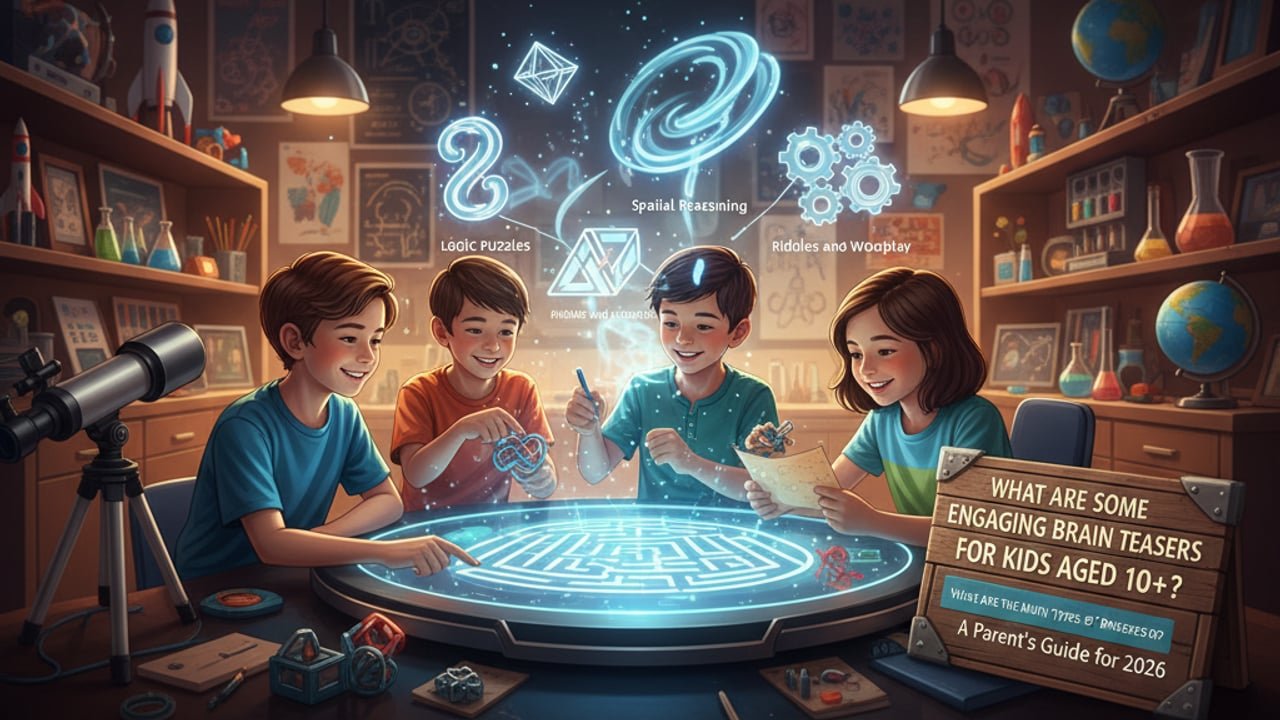
- Logic puzzles: sequencing, deduction, elimination (who owns the red house?)
- Math riddles: number patterns, simple algebra disguised as a story
- Verbal riddles and wordplay: homophones, double meanings, lateral thinking
- Spatial and visual puzzles: optical illusions, rotating shapes, hidden images
- Physical or mechanical puzzles: 3D objects that must be twisted, balanced or disassembled
Mixing categories across a week does more for overall cognitive flexibility than drilling one type repeatedly. A table helps to see which type suits which moment:
| Type | Skill developed | Typical time | Good for |
|---|---|---|---|
| Logic | Deductive reasoning | 5-10 min | Car trips, waiting rooms |
| Math | Numerical thinking | 3-8 min | Homework warm-ups |
| Verbal | Language flexibility | 1-3 min | Dinner table games |
| Spatial | Visual processing | 5-15 min | Rainy afternoons |
| Physical | Fine motor skills, persistence | 10-30 min | Desk or coffee table, screen-free evenings |
15 Brain Teasers for Kids Aged 10+, From Easy to Tricky
Here is a progressive set you can print or read aloud, ordered so a child can build confidence before hitting the harder ones.
🛍️ Our pick
Drone With Camera For Kids
Camera drones encourage spatial thinking and problem-solving, making them ideal for stimulating the minds of kids aged 10 and up.
From $94.99 Shop now →
Easy warm-ups
- What has a face and two hands but no arms or legs? A clock.
- What building has the most stories? A library.
- What has a neck but no head? A bottle.
- I’m tall when I’m young and short when I’m old. What am I? A candle.
Medium challenges
- A farmer has 17 sheep. All but 9 die. How many are left? 9.
- What five-letter word becomes shorter when you add two letters to it? Short.
- The more you take, the more you leave behind. What am I? Footsteps.
- Two fathers and two sons go fishing. Each catches one fish, yet only three fish are caught in total. How? They are a grandfather, father and son.
- I speak without a mouth and hear without ears. What am I? An echo.
Harder, for confident solvers
- A man looks at a portrait and says, “Brothers and sisters I have none, but this man’s father is my father’s son.” Who is in the portrait? His own son.
- You see a boat filled with people, yet there is not a single person on board. How? They are all married.
- What can travel around the world while staying in a corner? A stamp.
- Forward I am heavy, backward I am not. What am I? A ton.
- Three switches control three light bulbs in another room. You can flip switches only once before checking the bulbs. How do you identify which switch controls which bulb? Turn switch one on for a few minutes, switch it off, then turn switch two on before entering the room. The hot, unlit bulb matches switch one; the lit bulb matches switch two; the cold, unlit bulb matches switch three.
- What has keys but opens no locks? A piano.
💡 Did you know?
The tangram, one of the oldest spatial brain teasers still in circulation, dates back to China’s early 19th century and uses just seven flat shapes to form thousands of different silhouettes.
Is a 10-Year-Old’s Brain Fully Developed?
No, a 10-year-old’s brain is not fully developed, and it will not be until roughly the mid-twenties. According to research published by the US National Institutes of Health, while the brain reaches around 90% of its adult size by age six, the prefrontal cortex, the region governing planning, judgment and impulse control, continues maturing well into early adulthood. This is exactly why structured puzzles matter at this age: they give that still-developing reasoning network something productive to practice on.
⭐ Key takeaway
To remember: because the prefrontal cortex is still a work in progress at 10, short, frequent puzzle sessions beat one long marathon. Five minutes a day consistently outperforms a single hour once a week for building reasoning habits.
What Are Some Examples of Cognitive Development Activities Beyond Riddles?
Cognitive development at this age benefits just as much from tactile, mechanical challenges as from verbal riddles. Building and manipulating physical objects engages motor planning alongside pure logic, which written riddles cannot offer.
- Mechanical puzzles like the Pyramid Brain Teaser, which challenges a child to rebuild a geometric form from scattered pieces
- Balance and structural puzzles such as the Tensegrity Lego, which introduces the physics of tension and compression through play
- Classic strategy games: chess, checkers, logic grid puzzles like Sudoku
- Science-flavored curiosities, for instance exploring real chemical elements with a set like the Periodic Table with Real Element Samples, which turns memorization into tangible discovery
The full catalog of brain teasers we curate leans heavily on this physical, hands-on approach precisely because it keeps children at the table longer than a printed worksheet ever could.
What Are the Top 5 Mind Games for Kids?
The five mind games most frequently recommended by educators and occupational therapists for pre-teens are chess, Sudoku, memory card matching, tangram-style spatial puzzles, and physical disentanglement puzzles.
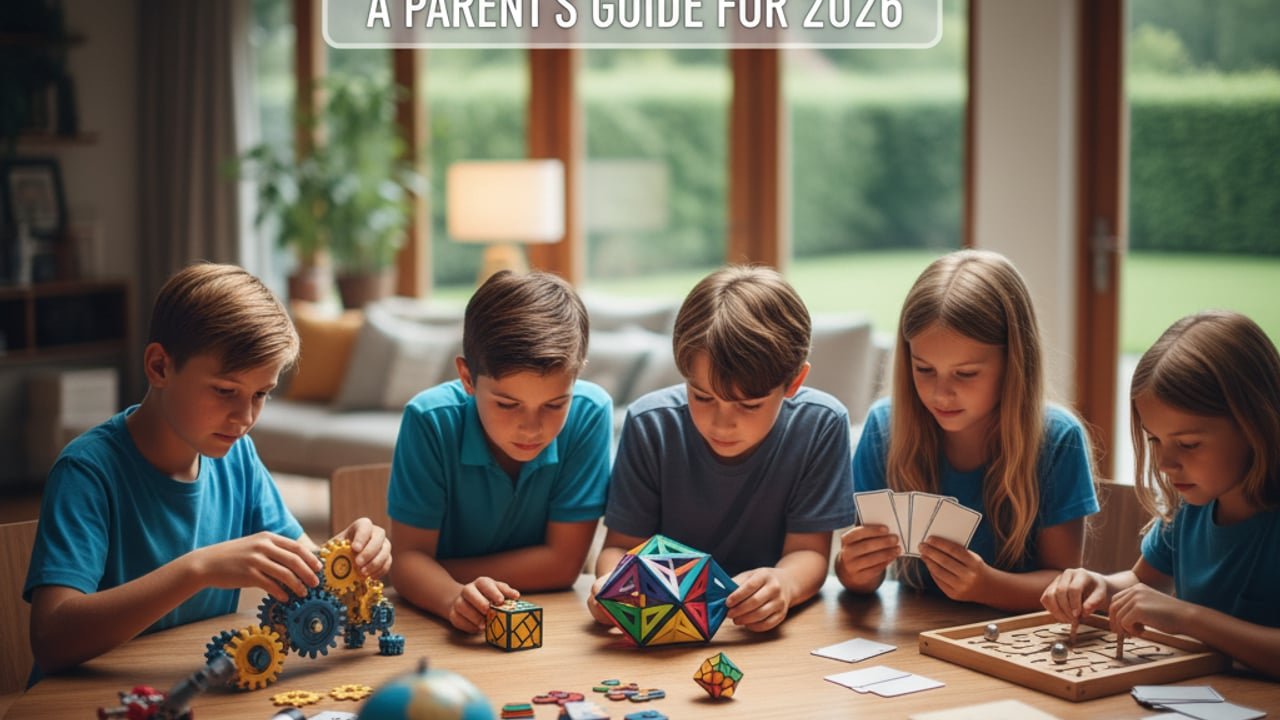
- Chess: long-term strategic planning
- Sudoku: logical elimination and number pattern recognition
- Memory matching games: short-term recall and attention
- Tangram or spatial puzzles: visual-spatial reasoning
- Disentanglement or mechanical puzzles: persistence and fine motor coordination
Rotating through these five keeps a child from plateauing on a single skill, which is the main complaint parents raise after a few months of sticking to one game type.
How to Create Your Own Brain Teasers at Home
Creating a homemade brain teaser is simpler than it sounds: start from a familiar object, then hide its identity behind a short, rhyming or paradoxical clue. Riddles built around household items (clocks, mirrors, shadows, candles) tend to land best because the child already has the mental image needed to solve it once the clue clicks.
- Pick an everyday object the child already knows well
- Describe it using contradictions (“I’m full of holes but still hold water”: a sponge)
- Test it on one person first and adjust the wording if it’s solved too fast or not at all
- Keep a running notebook of family-invented riddles for birthdays and car trips
Our Verdict
I’ve handed enough mechanical puzzles to enough fidgety ten-year-olds at museum events to have a firm opinion here: paper riddles are a brilliant warm-up, but it’s the object you can actually hold, twist and rebuild that keeps a child coming back on day three, day ten, day thirty. A folded sheet of riddles gets solved once and forgotten. A well-made physical puzzle sits on a desk, gets picked up during homework breaks, and quietly becomes part of a child’s thinking routine. If you’re choosing a gift rather than a worksheet, go physical every time.
💡 Did you know?
The Rubik’s Cube, invented by Hungarian architect Ernő Rubik in 1974, has roughly 43 quintillion possible configurations, yet can always be solved from any scrambled state in 20 moves or fewer, a result mathematicians call “God’s Number”.
Frequently Asked Questions
Sources
- US National Institutes of Health, National Institute of Mental Health, research on adolescent brain development
- Guinness World Records, entry on the Rubik’s Cube and “God’s Number” solving research
- British Psychological Society, publications on zone of proximal development and child cognitive learning