
The essentials:
- A plasma ball works by applying 2,000 to 5,000 volts of high-frequency AC current (around 25 to 40 kHz) to a small electrode sealed inside a low-pressure gas mixture, usually neon and argon.
- That voltage ionizes the gas, stripping electrons from atoms and creating glowing, branching filaments called plasma tendrils.
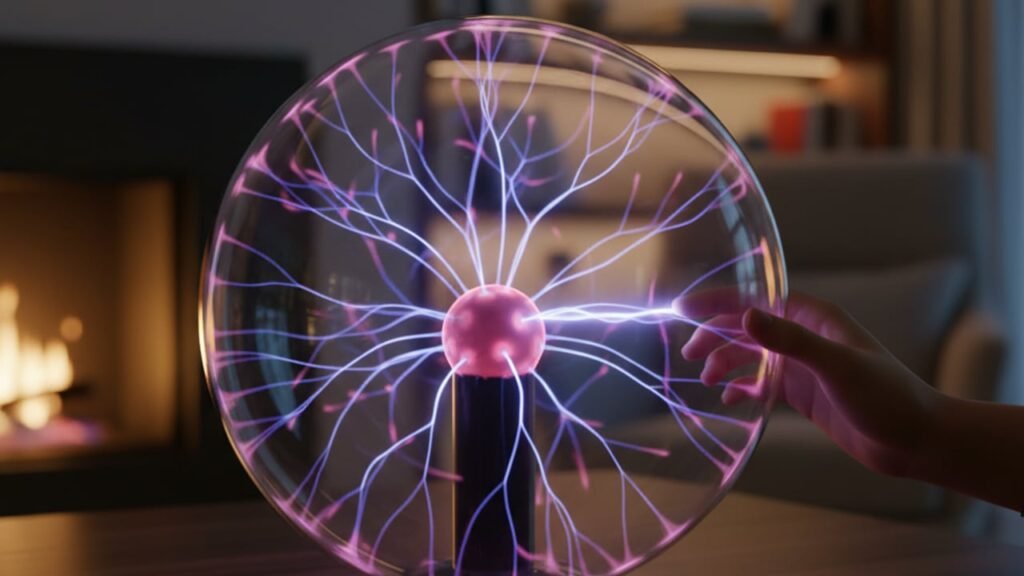
- Touching the glass gives the current an easier path to ground, so the tendrils rush toward your fingertip, brighter and thinner than before.
- Gas type and internal pressure determine the color you see, from violet-pink neon to blue-white argon mixes.
There is something almost hypnotic about watching a plasma ball do its thing. You touch the glass, and a thin purple filament snakes across the surface to meet your fingertip like it has a mind of its own. It looks like captured lightning, and in a very real sense, that is exactly what it is.
📋 Table of contents
- What Actually Makes the Tendrils Appear Inside the Glass?
- What Is Actually Inside a Plasma Ball?
- Why Do the Tendrils Follow Your Finger When You Touch the Glass?
- Why Do Plasma Balls Make a Buzzing or Crackling Sound?
- Why Are the Tendrils Different Colors?
- Our Verdict After Years of Curating Science-Driven Décor
- Frequently Asked Questions
What Actually Makes the Tendrils Appear Inside the Glass?
The tendrils appear because a central electrode generates between 2,000 and 5,000 volts of alternating current oscillating at roughly 25,000 to 40,000 times per second, and that rapid electric field rips electrons away from the gas atoms sealed inside the sphere. Once electrons separate from their atoms, you get a mix of free electrons and positively charged ions, which is the definition of plasma, often called the fourth state of matter alongside solid, liquid, and gas. The glowing filaments you see are simply the visible path that this ionized gas takes as it travels from the electrode toward the inner wall of the glass. The glass itself acts as a dielectric barrier, so the plasma never actually arcs through the glass. It travels along the inside surface, searching for the lowest-resistance path to complete its circuit.
Because the gas inside is sealed at low pressure, somewhere around 1 to 10 Torr compared to the 760 Torr of normal atmospheric pressure at sea level, the electrons can travel much farther between collisions than they would in ordinary air. That is precisely why a plasma ball can produce elegant, visible streamers using a few thousand volts, while generating a true lightning bolt in open air requires tens of millions of volts.
💡 Did you know?
Nikola Tesla experimented with glowing gas-discharge globes during his high-frequency research in the 1890s, decades before the tabletop plasma globe as we know it was patented by physicist Bill Parker in 1980.
What Is Actually Inside a Plasma Ball?
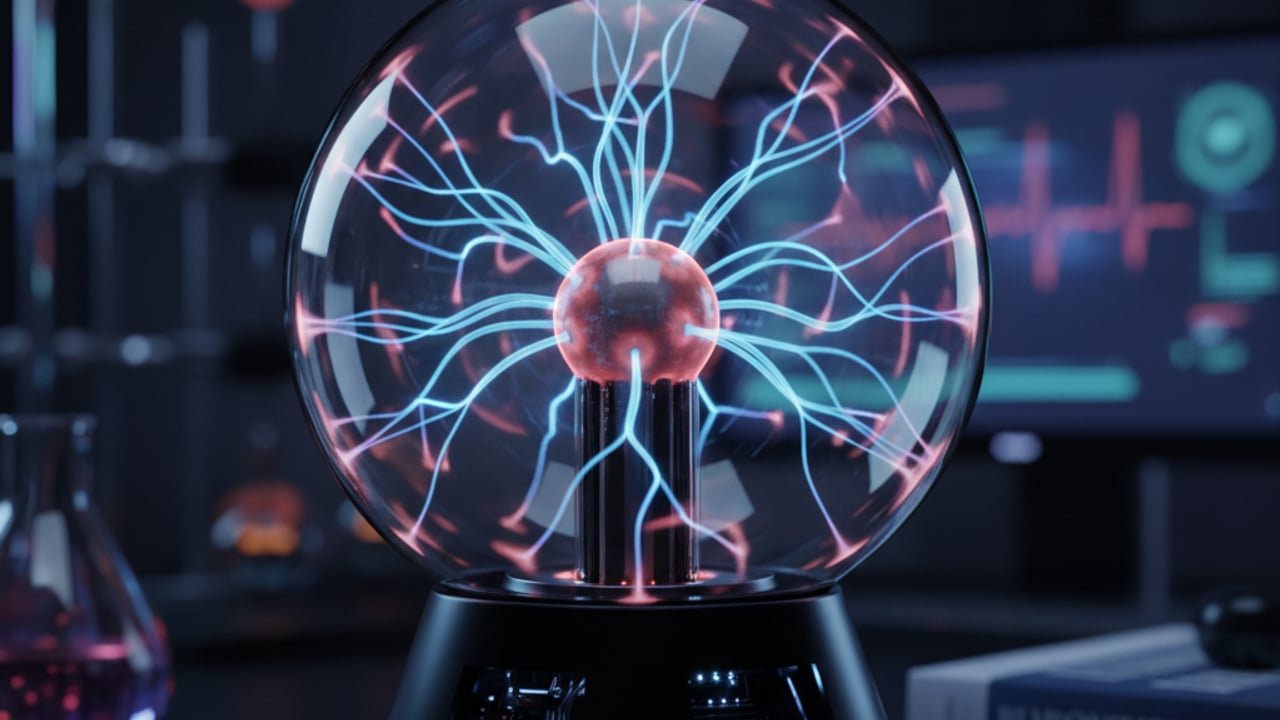
Inside the glass sphere sits a sealed mixture of noble gases, most commonly neon and argon, kept at a pressure far below normal atmospheric levels. These particular gases are chosen because they ionize at relatively low voltages and produce a visually striking glow instead of a dim or colorless discharge. A central glass or metal electrode runs through the middle of the sphere, connected to a small high-voltage transformer or inverter circuit hidden in the base. That base unit is doing the real engineering work, stepping up standard wall voltage and converting it into the high-frequency, high-voltage signal that the electrode needs to ionize the gas continuously.
None of this makes a plasma ball a scientific instrument in the lab-grade sense. It is a decorative and educational device, built for visual effect and curiosity rather than precision measurement, and it should always be treated as such, especially around children.
⭐ Key takeaway
If you are shopping for a glowing display piece that pairs well with a plasma ball’s retro-futuristic charm, a lava lamp night light or a space projector both create that same hypnotic, conversation-starting ambiance on a shelf or desk.
Why Do the Tendrils Follow Your Finger When You Touch the Glass?
The tendrils chase your fingertip because the human body is an excellent conductor compared to the surrounding air, which gives the plasma a far easier path to ground. This is a capacitive coupling effect: your finger, the glass, and the ionized gas form a circuit where electrical charge can flow more efficiently than it can through still air alone. The result is that filaments which were previously spread evenly across the globe suddenly concentrate into a single brighter, thinner tendril that bends toward wherever you place your hand. It is the same underlying physics that makes static electricity jump to a doorknob, just continuously sustained by the oscillating high-voltage signal inside the ball.
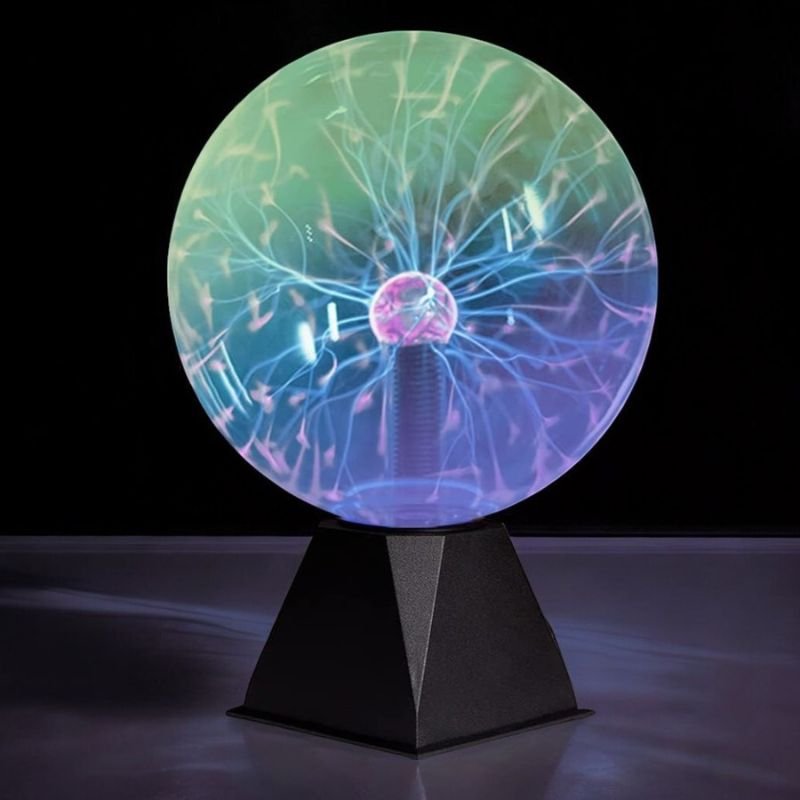
🛍️ Our pick
Plasma Ball Art
Plasma Ball Art demonstrates the principles of plasma physics through its mesmerizing, interactive lightning-like tendrils that respond to touch.
109,99 $
If you touch the glass with two fingers from different hands, or let a friend touch the opposite side, you can watch the plasma split or redirect itself between multiple contact points, which is a fun way to demonstrate how plasma naturally seeks the path of least resistance.
Why Do Plasma Balls Make a Buzzing or Crackling Sound?
That faint buzz or crackle comes from the same high-frequency oscillation that powers the ionization, typically in the 25 to 40 kHz range mentioned earlier, which sits close to the upper edge of human hearing. As the internal circuit switches on and off thousands of times per second, it creates tiny vibrations in the air and in the glass itself, audible as a soft electronic hum. Some units also emit a crackling noise when the plasma filaments jump or split suddenly, similar in principle to the crack of a much larger lightning bolt, just dramatically scaled down in both voltage and sound energy.
Why Are the Tendrils Different Colors?
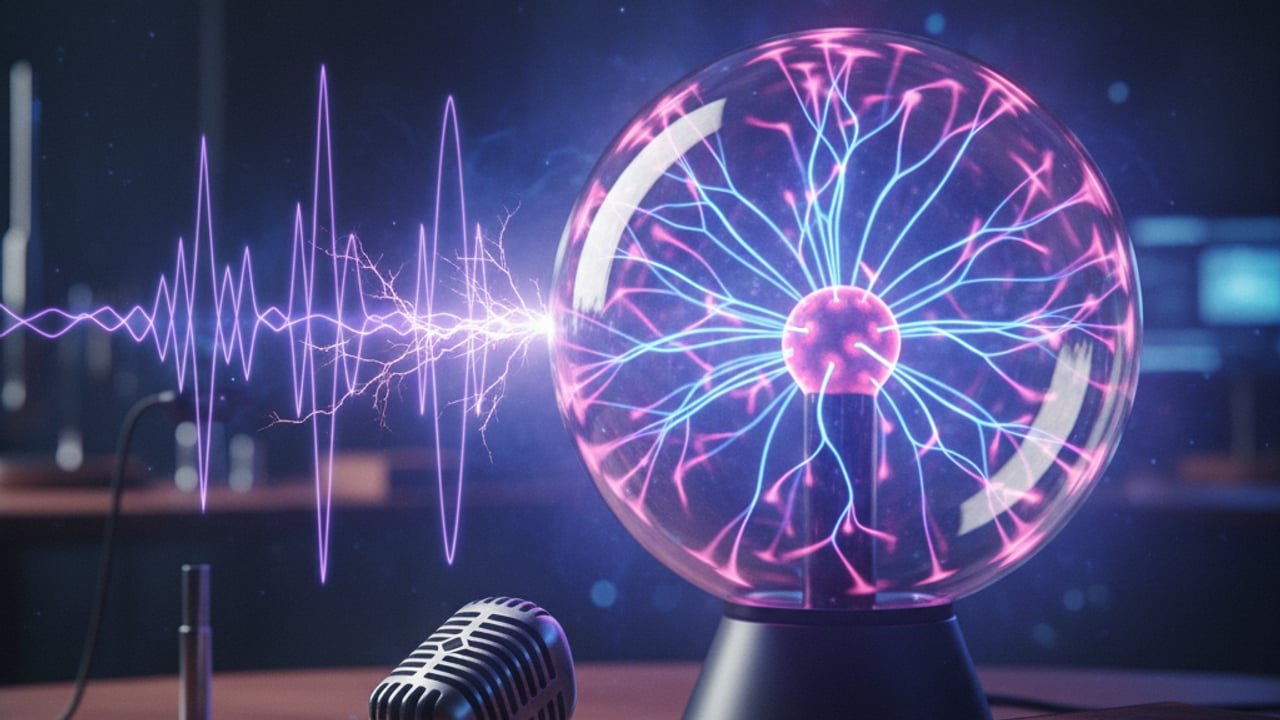
The color of the tendrils depends almost entirely on which noble gas or gas mixture is sealed inside the globe, since each element emits a characteristic wavelength of light when its electrons are excited and then return to a lower energy state. Neon typically glows reddish-orange to pink-violet, argon produces a cooler blue-violet tone, and some manufacturers blend gases or use colored glass to create custom palettes like teal or magenta. This is the exact same principle behind neon signage and the colors seen in aurora displays, where different atmospheric gases glow in different colors depending on altitude and composition.
💡 Did you know?
The aurora borealis gets its green glow primarily from oxygen atoms roughly 60 to 150 miles above Earth, while nitrogen contributes the pinks and purples, a natural large-scale cousin to what happens inside your plasma ball on a miniature, controlled scale.
Our Verdict After Years of Curating Science-Driven Décor
I have watched hundreds of visitors at science fairs and in my own showroom reach out to touch a plasma ball within seconds of seeing it glow, and that instant reaction never gets old. From a curator’s perspective, a well-made plasma ball earns its place as a genuine statement piece, not a novelty that gets shelved after a week. The physics behind it is real, the visual payoff is immediate, and it sparks more unprompted conversation than almost any other desk object I have sold. My only real caveat: treat it like the decorative, educational device it is, not a lab tool, and keep it away from magnetically sensitive electronics given its proximity to other favorites like magnetic balls or a precision gyroscope on the same shelf.
For families with curious kids, plasma balls are generally suited to ages 8 and up, with adult supervision recommended since the glass globe can crack under heavy impact and the base contains electrical components. Pair it with other hands-on favorites from our cool gadgets collection for a full sensory science corner.
Frequently Asked Questions
Sources
- Nikola Tesla’s lectures and patents on high-frequency gas-discharge experiments, late 1800s
- U.S. Patent records attributing the modern plasma globe design to physicist Bill Parker, 1980
- NOAA and NASA public data on auroral emission colors and atmospheric gas composition