

The essentials:
- A Galileo thermometer works because liquid density changes with temperature, making sealed glass bulbs rise or fall.
- Each bulb is weighted and calibrated at the factory so only specific bulbs float at specific temperatures, typically covering a 64°F to 80°F indoor range.
- You read the temperature from the lowest bulb still floating in the upper cluster, not the one sitting at the very top.
- It is a beautiful decorative and educational piece, not a lab-grade instrument, and it reacts slowly to temperature swings.
A Galileo thermometer turns a 17th-century physics experiment into a floating, glowing centerpiece for your desk or bookshelf. Before you buy one or gift one to the science lover in your life, it helps to know exactly why those glass bulbs rise and fall, and why that slow, mesmerizing drift is actually precise physics at work.
📋 Table of contents
- What Is the Science Behind a Galileo Thermometer?
- How Does Density Explain the Floating Bulbs?
- Why Are the Bulbs Labeled With Specific Temperatures?
- How Do I Read a Galileo Thermometer?
- What Is the Fluid Inside a Galileo Thermometer?
- What Is the Main Principle Behind This Thermometer?
- Where Is the Best Place to Put a Galileo Thermometer?
- What Are the Limitations of a Galileo Thermometer?
- Did Galileo Actually Invent This Thermometer?
- Our Verdict
- FAQ
What Is the Science Behind a Galileo Thermometer?
A Galileo thermometer measures temperature using density differences between a sealed liquid and a set of weighted glass bulbs rather than mercury expansion. As the liquid inside the tube warms or cools, its density shifts just enough to make some bulbs sink while others rise, and the position of the bulbs tells you the temperature. This is the same density principle Galileo Galilei explored in his 1612 treatise on floating bodies, even though the actual instrument came later.
💡 Did you know?
Despite the name, Galileo likely never built this exact device. Historians generally credit the Accademia del Cimento in Florence, a scientific academy founded in 1657, with developing the floating-bulb thermometer as a tribute to Galileo’s earlier work on buoyancy.
How Does Density Explain the Floating Bulbs?
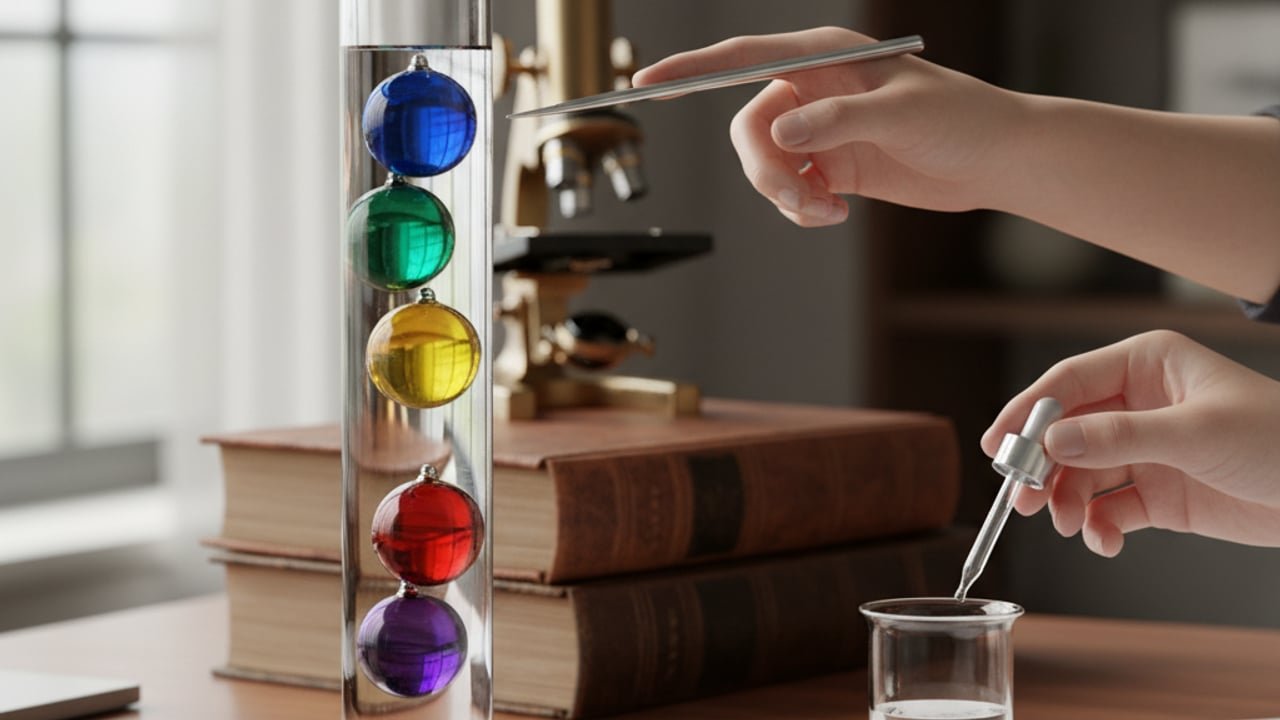
Density explains the floating bulbs because warmer liquid expands and becomes less dense, while cooler liquid contracts and becomes denser. Inside the sealed glass cylinder, a clear liquid (often a blend of water and alcohol or a mineral-oil mix) fills the tube, and glass bulbs filled with colored liquid and a metal tag act as weighted floats. When room temperature rises, the surrounding fluid thins out and loses density, so it can no longer support as many bulbs, and the heavier ones sink while lighter-relative bulbs rise toward the top. When temperature drops, the fluid thickens and becomes denser, pushing more bulbs upward. It is the same buoyancy logic that keeps a ship afloat, just finely tuned to a few degrees of difference.
Why Do Some Bulbs Float While Others Sink at the Same Time?
Some bulbs float while others sink simultaneously because each one is calibrated to a slightly different density using tiny metal weights attached underneath. Manufacturers adjust each bulb’s weight so it matches the surrounding liquid’s density at one specific temperature. Since the bulbs are made in a sequence, usually one or two degrees apart, you get a visual gradient instead of a single on-off reaction.
Why Are the Bulbs Labeled With Specific Temperatures?
The bulbs are labeled with specific temperatures because each one is individually calibrated at the factory to match the density of the surrounding fluid at that exact reading. Technicians fine-tune the weight at the base of each bulb in a water bath set to the target temperature, so the bulb becomes neutrally buoyant only within a narrow range around that number. This calibration step is the part most explanations skip, yet it is the entire reason a decorative glass tube can double as a working thermometer. Most consumer models sold in the US are calibrated across a 64°F to 80°F range, which covers typical indoor room temperatures without needing extreme highs or lows.
🛍️ Our pick
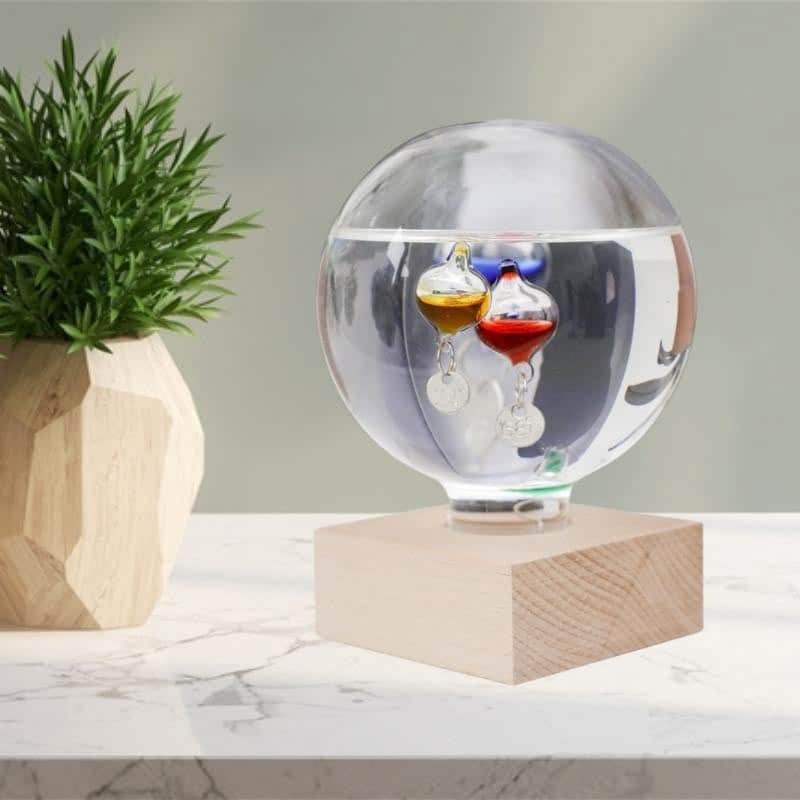
Galileo Temperature Thermometer
A Galileo thermometer uses glass bulbs filled with liquid of varying densities to indicate temperature changes through buoyancy principles.
62,99 $
⭐ Key takeaway
The magic isn’t in the glass, it’s in the invisible weight hidden inside each bulb. That tiny calibration step is what turns a simple floating-bulb display into an actual working thermometer.
How Do I Read a Galileo Thermometer?
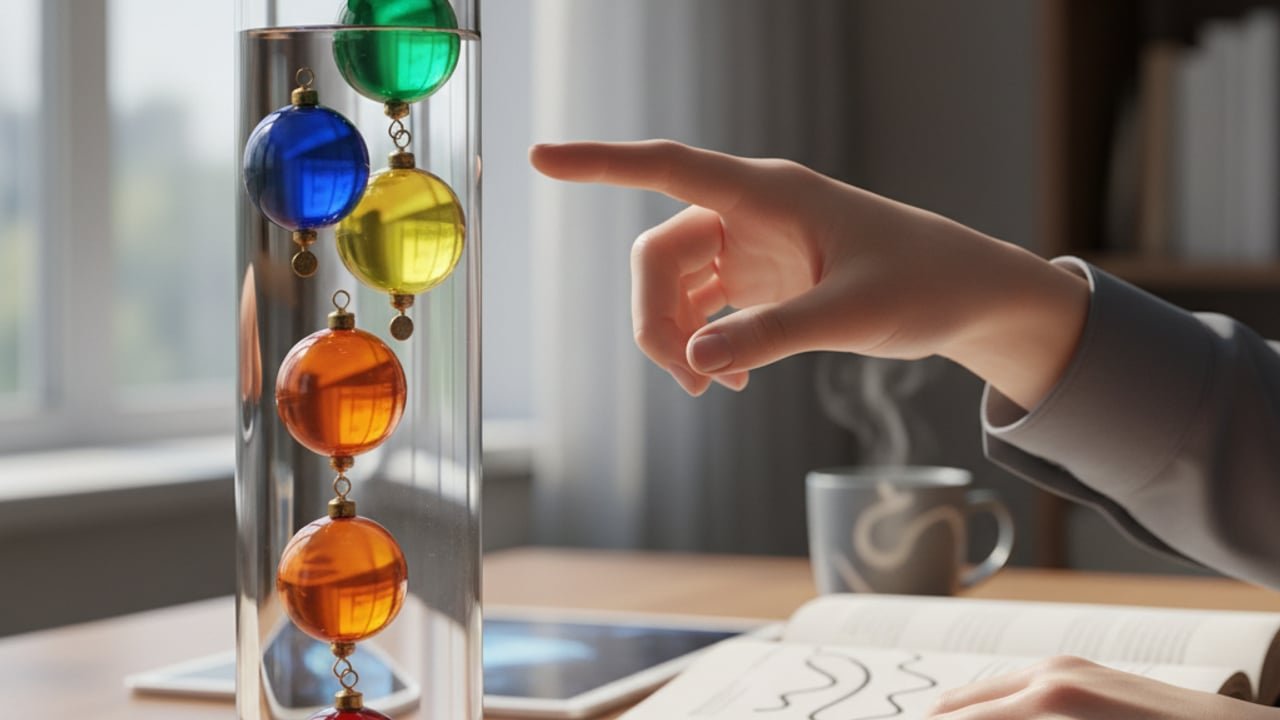
To read a Galileo thermometer, look at the bulbs floating in the upper half of the tube and find the lowest one still floating, since that bulb’s tag shows the current temperature. Here is the step-by-step method:
- Locate the cluster of bulbs floating near the top of the tube.
- Ignore any bulbs resting on top of each other near the very top unless they’re the only group floating.
- Find the single lowest bulb in that floating group, the one closest to the gap where bulbs below it have sunk.
- Read the number on that bulb’s metal tag. That number is your current room temperature in Fahrenheit.
- If two bulbs are floating at the same level with a visible gap below, the temperature sits between the two readings.
Reading takes a few seconds once you know the trick, but remember these instruments respond slowly to change, often taking 10 to 20 minutes to settle after a shift in room temperature.
What Is the Fluid Inside a Galileo Thermometer?
The fluid inside a Galileo thermometer is typically a clear liquid such as purified water mixed with ethanol, or in some models a mineral oil blend, chosen specifically because its density changes predictably and smoothly with temperature. This liquid fills the sealed outer tube completely, leaving no air gap, which prevents oxidation and keeps the bulbs moving freely for years without needing maintenance.
What Is the Main Principle Behind This Thermometer?
The main principle behind this thermometer is thermal expansion of liquids combined with Archimedes’ principle of buoyancy. As a liquid’s temperature rises, its molecules spread apart and its density drops; as temperature falls, molecules pack closer and density increases. Buoyancy then determines whether a weighted bulb floats or sinks, since an object floats when it is less dense than the fluid around it and sinks when it is denser. Combine those two physical laws and you get a working, mercury-free thermometer that has been displayed on shelves since the 1600s.
Where Is the Best Place to Put a Galileo Thermometer?
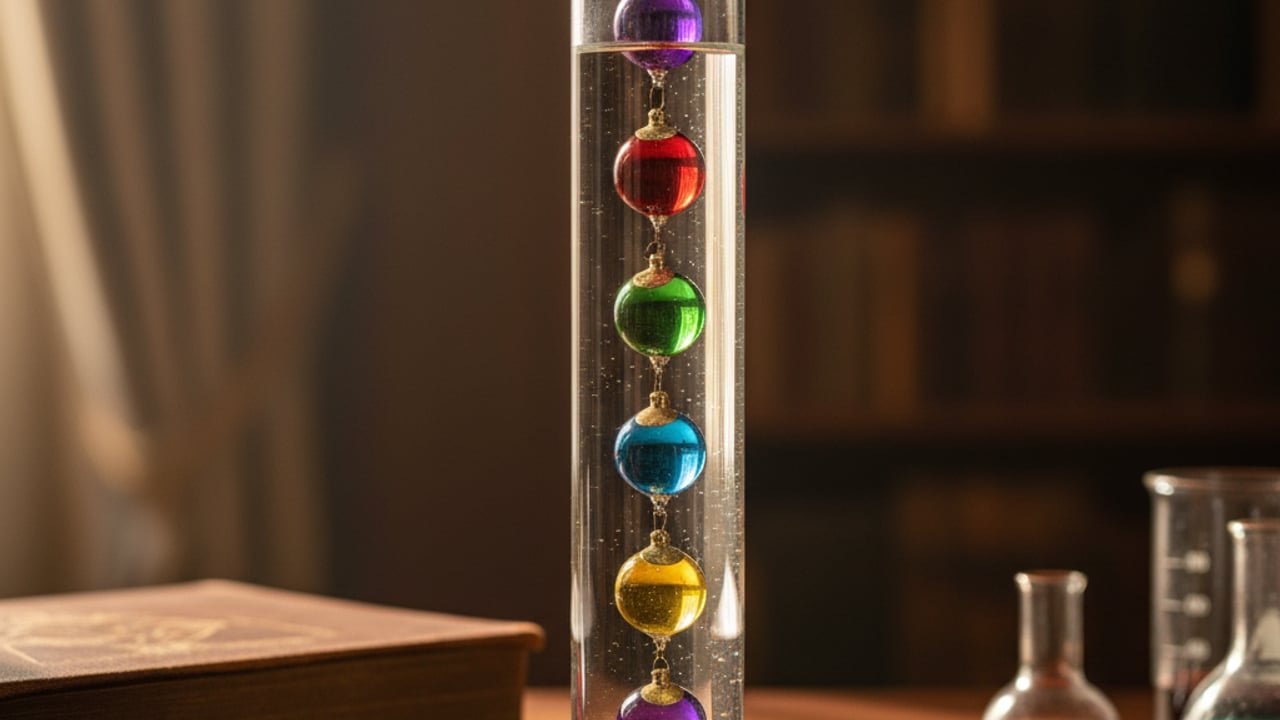
The best place to put a Galileo thermometer is an indoor spot with stable ambient temperature, away from direct sunlight, heating vents, air conditioning drafts, or windows, since those sources create rapid fluctuations the slow-reacting fluid cannot track accurately. A bookshelf, a desk corner, or a mantelpiece works well, both for accuracy and for visibility as a statement piece. Avoid placing it near a drafty entryway or a kitchen stovetop, where temperature swings happen faster than the liquid inside can adjust.
💡 Did you know?
Galileo thermometers are sometimes called “galilean thermometers,” and physics researchers have pointed out in published analyses that the device measures the thermometer’s own internal fluid temperature, not the air temperature directly, with a noticeable time lag between the two.
What Are the Limitations of a Galileo Thermometer?
The main limitations of a Galileo thermometer are its slow response time, its coarse precision compared to digital sensors, and its sensitivity to placement and liquid aging over many years. Because each bulb only floats within roughly a 1 to 2 degree window, you get a stepped reading rather than a precise decimal value, which makes it a decorative conversation piece rather than a clinical measuring tool. Atmospheric pressure changes can also nudge accuracy very slightly over time, though this effect is minor for home use. None of this takes away from its charm, it just means you should treat it as a beautiful, slow-motion science demonstration rather than a weather station replacement.
Did Galileo Actually Invent This Thermometer?
No, Galileo likely did not invent the floating-bulb thermometer that bears his name, though his 1612 work on buoyancy and floating bodies laid the scientific groundwork for it. Historical records point to members of the Accademia del Cimento in Florence, working decades after Galileo’s death in 1642, as the ones who built the first practical floating thermometers using his principles. The name stuck because the underlying physics, density and buoyancy, trace directly back to his published experiments.
Our Verdict
I’ve handled dozens of these over the years, and what still gets me is how a piece of 17th-century physics can sit quietly on a shelf and still spark a conversation every single time someone notices the bulbs have shifted. A well-made Galileo thermometer, like our own Black Galileo Thermometer, earns its place as both a functional room thermometer and genuine desk decor, provided you set realistic expectations about precision and response time. If you love slow, density-driven motion, it pairs beautifully on a shelf next to a Lava Lamp Night Light, since both rely on the same physics of fluids shifting density with heat. For anyone building out a desk full of science-driven conversation starters, browse our Cool Gadgets collection for more pieces built on real physical principles rather than gimmicks.
FAQ
Sources
- Western Washington University, Department of Physics & Astronomy
- ACS Publications, Journal of Chemical Education
- Accademia del Cimento historical records, Florence