
The essentials:
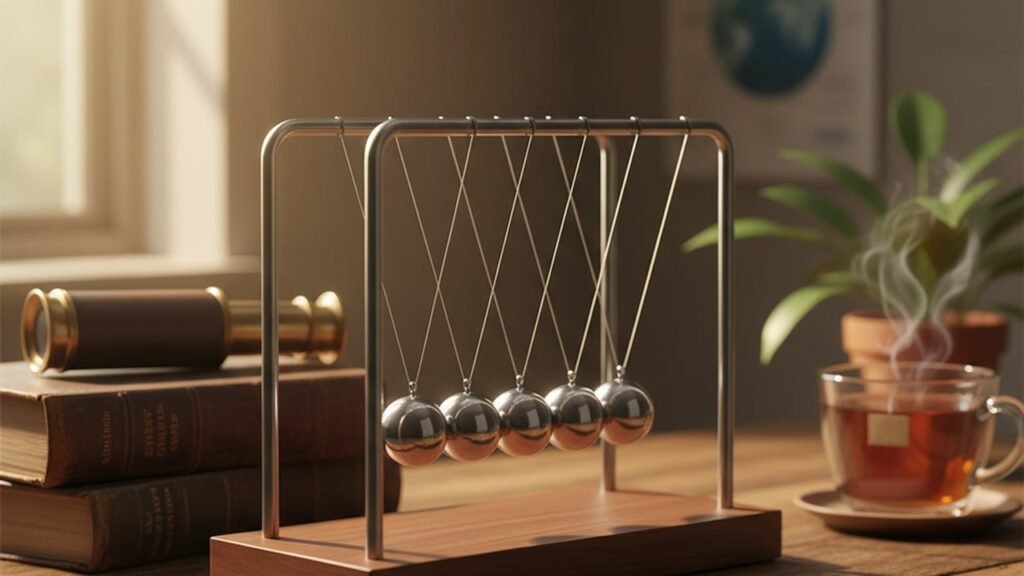
- A Newton’s Cradle demonstrates the conservation of momentum and energy through a chain of swinging steel balls, each collision passing motion almost unchanged to the far end.
- Despite the name, Sir Isaac Newton never built or owned one; the desktop toy was named in his honor by English actor Simon Prebble in 1967.
- A classic five-ball cradle sits happily on a desk or shelf and works as a genuine science-based decor piece, not just a novelty.
- When buying one, prioritize ball-to-ball alignment, frame stability and steel quality over sheer size.
There’s a particular kind of quiet satisfaction in pulling back that first steel ball, letting go, and watching the last one leap into the air while the middle three stay perfectly still. It’s the sound of physics doing exactly what it’s supposed to do, and it’s oddly hypnotic even after you’ve seen it a hundred times. That’s the enduring charm of the Newton’s Cradle, a desk toy that’s been quietly educating and entertaining people since the 1960s, and one Dr. Emily Sterling still keeps on her own windowsill, mostly to fidget with during phone calls.
📋 Table of contents
- What exactly is a Newton’s Cradle?
- How does a Newton’s Cradle actually work?
- Did Isaac Newton actually invent the cradle that bears his name?
- Why is a Newton’s Cradle such a popular gift?
- How do you choose a good Newton’s Cradle?
- Is a Newton’s Cradle suitable for children?
- Our verdict
- Frequently asked questions
What exactly is a Newton’s Cradle?
A Newton’s Cradle is a set of identical metal balls suspended in a row by pairs of strings from a frame, designed so that lifting and releasing an end ball transfers its motion almost perfectly through the row to the ball at the opposite end. The device is a physical demonstration of two fundamental conservation laws: momentum and kinetic energy. When one ball strikes the row, the collision is very nearly elastic, meaning almost no energy is lost to heat, sound or deformation, so the last ball flies off with nearly the same speed as the first ball had on impact.
Most cradles you’ll find today use five polished steel balls, though variants with seven or nine balls exist for a slightly more dramatic ripple effect. The balls typically measure between 2 and 4 cm in diameter on desktop versions, with frames ranging from compact 15 cm units to statement pieces over 30 cm wide.
💡 Did you know?
Did you know? If you lift two balls at once and release them, exactly two balls fly out the other side, never one ball moving twice as fast. This precise, repeatable outcome is what makes the cradle such a clean teaching tool for momentum conservation.
How does a Newton’s Cradle actually work?
The short answer: each collision transfers momentum through the chain almost losslessly because the balls behave as nearly perfectly elastic bodies. When ball one strikes ball two, the force travels through the touching balls as a compression wave at the speed of sound in steel, arriving at the far end in a fraction of a millisecond. Because momentum (mass times velocity) must be conserved and because so little energy is lost, the system essentially has only one way to satisfy both conservation laws at once: send the same number of balls off the far end at the same speed as arrived at the near end.
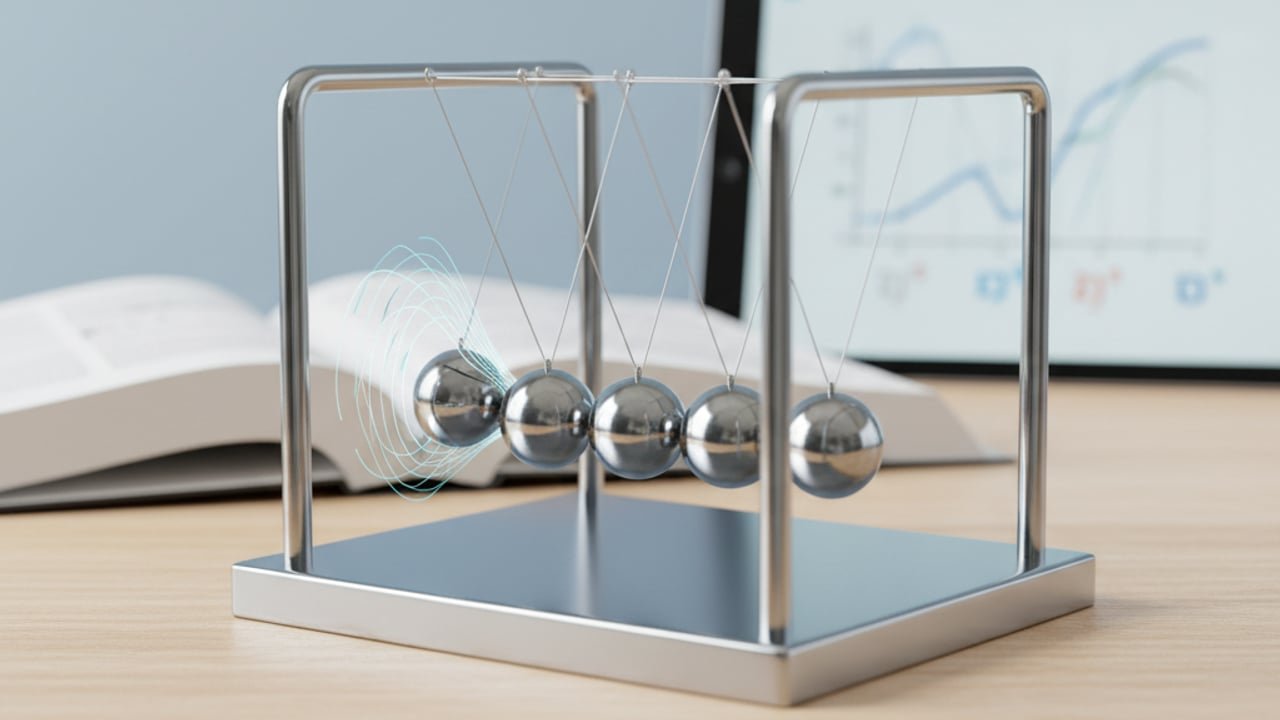
Friction and air resistance do gradually slow the swinging, which is why the balls eventually settle into a gentle synchronous rocking rather than swinging forever. A well-made cradle with hardened steel balls and taut strings will keep a clean, sharp motion for much longer than a cheap plastic imitation, where wobbly alignment causes energy to scatter sideways instead of transferring cleanly.
⭐ Key takeaway
To retain: the quality of a Newton’s Cradle comes down almost entirely to how precisely the balls are aligned and how rigid the frame is. A wobbly, misaligned cradle looks the same on a shelf but performs far worse when you actually swing it.
Did Isaac Newton actually invent the cradle that bears his name?
No, Isaac Newton did not invent or build the device now called a Newton’s Cradle. The underlying physics traces back to French physicist Edme Mariotte, who described the collision behavior of elastic spheres as early as 1671, decades before Newton published his own laws. Newton himself, born in 1642 and died in 1727, formalized the three laws of motion in his 1687 work Philosophiæ Naturalis Principia Mathematica, which explains why later scientists and toy-makers borrowed his name to describe the phenomenon, even though he never assembled the desktop device we know today.

🛍️ Our pick
Newton Pendulum Perpetual
Understanding the physics of Newton’s pendulum helps explain why these devices keep up an apparently perpetual swinging motion.
[sg_price id=”199″] Shop now →
The modern toy as we recognize it was named and popularized by English actor Simon Prebble in 1967. Working for a company producing executive desk novelties, Prebble coined the term “Newton’s Cradle” as a tribute to Newton’s second and third laws of motion, and the name stuck permanently in popular culture. So the cradle is really a 20th-century tribute object celebrating 17th-century physics, which is a rather charming bit of scientific storytelling in itself.
💡 Did you know?
Did you know? The Newton’s Cradle became a fixture of 1980s office desks partly thanks to its appearance in films and television as shorthand for “intelligent executive,” a reputation the object has never quite shaken off.
Why is a Newton’s Cradle such a popular gift?
A Newton’s Cradle works as a gift because it manages to be genuinely educational, visually elegant and endlessly fiddle-worthy all at once, which is a rare combination for a desk object. Unlike a purely decorative trinket, every swing of the cradle demonstrates a real physical law, giving the recipient something to actually talk about rather than just glance at.
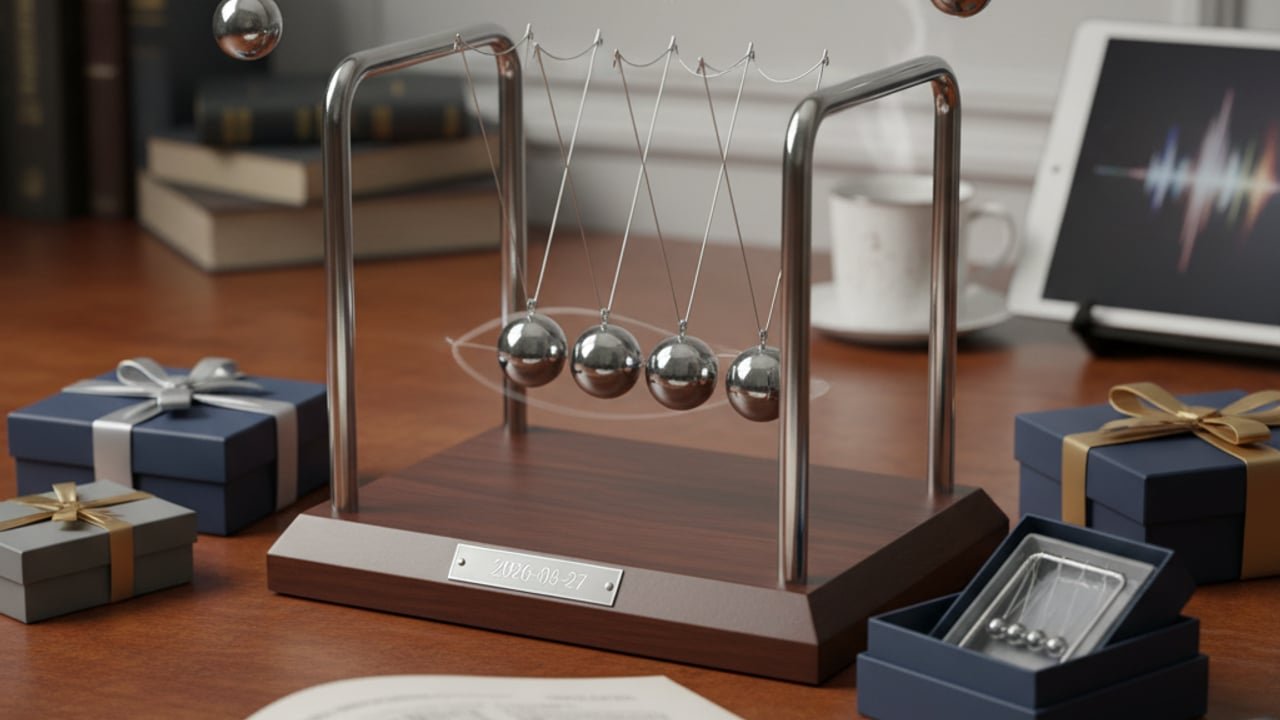
It suits a wide range of occasions: a retirement gift for a former physics teacher, a housewarming present for someone who likes their shelves to spark conversation, or a stocking stuffer for the curious teenager who dismantles everything they own to see how it works. If you’re shopping for someone who already owns one, browsing the wider brain teasers collection or the broader range of cool gadgets tends to turn up complementary desk pieces they won’t already have.
Good pairings for a science-lover’s desk
- A Pyramid Brain Teaser for someone who likes puzzles alongside their physics demos.
- A Tensegrity Lego structure, which plays with balance and tension rather than momentum.
- A Tesla Coil Music set for the recipient who wants electricity as well as mechanics on display.
- A Magnetic Perpetual Calendar to round out a desk that’s already leaning scientific.
How do you choose a good Newton’s Cradle?
Choosing well means looking past the frame’s finish and checking the mechanics that actually determine how the toy performs over years of use. The three things worth checking before buying are ball alignment, string tautness and the base material, since these determine whether the cradle swings cleanly or clatters unevenly within weeks.
| Feature | What to look for | Why it matters |
|---|---|---|
| Ball material | Polished stainless or chrome steel | Harder, denser metal loses less energy per collision |
| Frame | Solid wood or weighted metal base | A light frame absorbs energy through wobble instead of transferring it |
| String setup | Double-string cradle, evenly tensioned | Keeps balls swinging in a single plane rather than drifting sideways |
| Size | 15-25 cm for desks, 30 cm+ for shelves | Larger cradles are more visually striking but need more clearance to swing |
⭐ Key takeaway
To retain: if a cradle’s balls visibly drift out of line after a few swings, it’s an alignment or tension fault, not a sign you’re using it wrong. A well-built cradle should swing cleanly in one plane for dozens of cycles.
Is a Newton’s Cradle suitable for children?
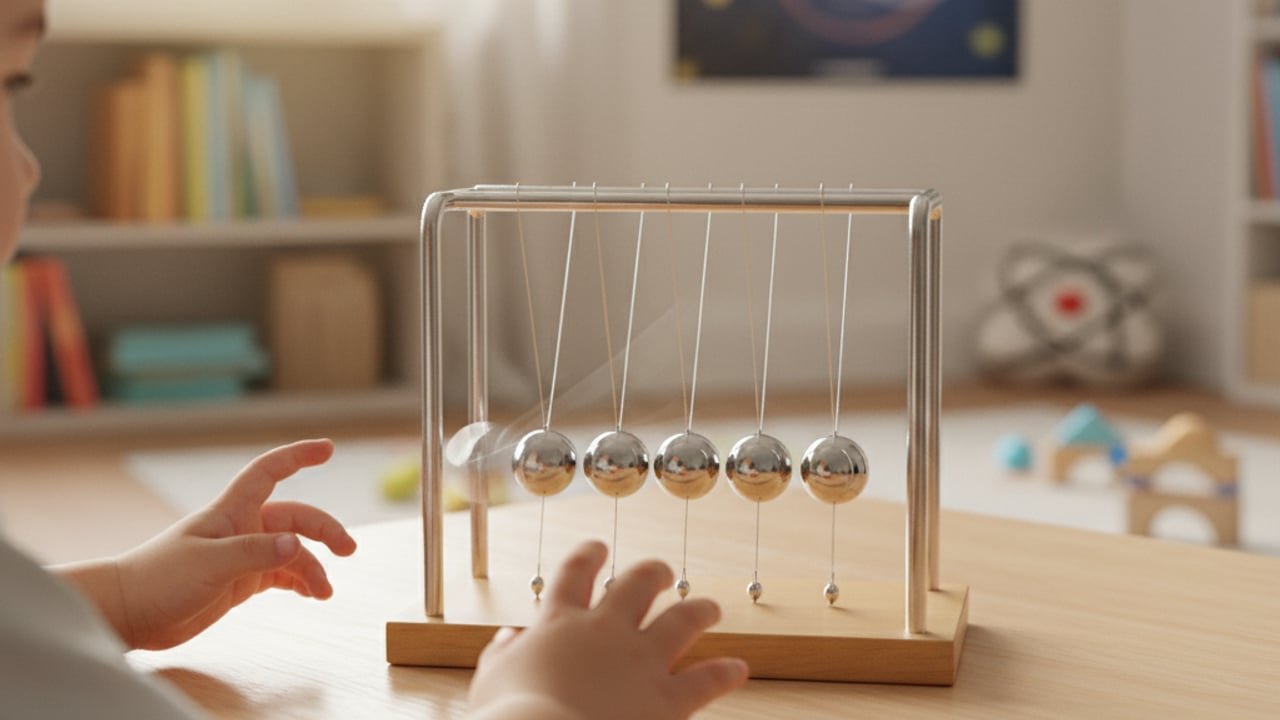
A Newton’s Cradle can be a great introduction to physics for curious children, generally recommended from around 8 years upwards given the small metal balls and strings involved. As with any desk toy containing small dense components, adult supervision is sensible for younger children, and it’s worth checking the manufacturer’s specific age guidance printed on the packaging before gifting one to a child under school age.
Our verdict
Dr. Emily Sterling’s take: after testing more cradles than she’d like to admit across two decades of gift-shop curating, the ones worth owning are the ones with genuinely taut double strings and a base heavy enough not to shuffle across the desk mid-swing. Cheap versions look identical in a photo but fall apart mechanically within a month; a properly built one will still be swinging cleanly on your desk in ten years, quietly proving Newton’s laws every time someone can’t resist giving it a flick.
Frequently asked questions
If you enjoy watching the principles of physics in action, you’ll be fascinated by gyroscope operation and uses.
Did that lesson in kinetic energy and momentum spark your interest? Discover another electrical marvel that illuminates the principles of electromagnetism.
Also explore how desk toys for focus can support your concentration at work, easing stress while sharpening mental clarity.
If you’re intrigued by the elegant physics behind Newton’s Cradle, you might also appreciate the perfect blend of science and art in our math gifts guide.
Explore the precision of physics in motion, then discover how timekeeping marvels blend science with style in our geek watches guide.
If you’re fascinated by the science behind iconic objects, you’ll love exploring the gifts inspired by science fiction.
If you enjoyed exploring the physics of motion here, you might also love discovering the microscopic world with our guide to scientific exploration tools.
Delve further into the fascinating world of classic physics models by building a Stirling engine.
For a perfect example of a classic physics toy that makes a brilliant gift, explore our full guide to gifts for science lovers.
If you love objects that defy gravity, find out how a levitating globe works.
If you enjoy the physics of interactive objects, you might also like our guide to quality puzzle selection.
If you’re fascinated by the physics of kinetic energy in a Newton’s Cradle, you might also enjoy exploring how plasma balls work to see another captivating display of energy in motion.
Sources
- Isaac Newton, Philosophiæ Naturalis Principia Mathematica, 1687
- Encyclopaedia Britannica, entries on Isaac Newton and conservation of momentum
- Historical accounts of Edme Mariotte’s studies on collision of elastic bodies, 17th century